Stop Guessing: Flowtly's Budgeting Reveals Your True CAC and LTV
If you're an ambitious business owner, you know your numbers are everything. Two of the most critical are Customer Acquisition Cost (CAC) – what it costs you to acquire a customer – and Lifetime Value (LTV) – how much revenue (and profit) a customer brings in over their lifetime. Tracking these metrics accurately is the difference between scaling profitably and burning cash. Yet many companies rely on rough averages or vanity metrics, missing the specific details you need to make smart decisions.
Flowtly, our AI-ready business management platform, helps you accurately calculate CAC and LTV using your actual budget data. In this article, we'll show you how Flowtly’s budgeting tools help you:
- Track every dollar (and hour) spent on marketing and sales, including internal labor, external spend, and tools.
- Attribute those costs to specific clients, channels, and campaigns for true clarity on Channel ROI.
- Measure profitability per client – not just overall – by factoring in time and resources spent serving each one.
- See each client’s true LTV based on actual usage, engagement, and revenue over time (net of costs).
- Uncover clear insights about which clients are truly valuable, which channels to invest more in, and which acquisition efforts are simply draining your budget.
No fluff, no vanity metrics – just honest data business owners can act on. Let's look at how Flowtly provides the clarity you need to make confident choices.
Tracking Every Marketing Cost with Precision (No More Hidden Expenses)
To truly understand your CAC, you need to count every single cost involved in acquiring a customer. Most companies calculate CAC too narrowly, focusing only on obvious costs like ad spend. In reality, customer acquisition cost should include all sales and marketing expenses and related overhead. This means not just your Facebook or Google Ads budget, but also:
- Internal labor: The salaries or hours of your marketing team, sales reps, content creators, etc., devoted to winning customers. Those hours have a cost.
- External spend: Ad campaigns, agency fees, sponsorships, webinar costs, paid tools for outreach, etc.
- Software and tools: The CRM software, analytics tools, design subscriptions, and any other platforms used solely for acquiring customers.
- Overhead allocation: A share of general costs (office space, finance support, etc.) that exist to support your sales & marketing engine.
Ignoring any of these expenses means you're understating your true CAC. This creates a false sense of efficiency, risking premature over-investment. In other words, if you don’t count your internal team’s time or that fancy marketing software in CAC, you might think acquiring customers is cheaper than it really is – and overspend as a result.
Flowtly’s budgeting module ensures no cost falls through the cracks. It lets you track all costs, whether they're for a specific client or a project, in one centralized place. You can log or import every transaction and invoice, then associate those costs with a specific budget or campaign. For example, you might create a budget for “Q1 Marketing” or even separate budgets for “Q1 – Google Ads”, “Q1 – Content Marketing”, etc. Flowtly allows you to add costs in multiple ways:
- Link bank transactions (e.g., an ad platform charge on your credit card) directly to the relevant campaign’s budget.
- Link contractor or vendor costs (freelancers, agencies) to the budget so their invoices roll up into the total.
- Associate internal project phases with budgets – for instance, link a content project or a sales initiative to the marketing budget, capturing internal work costs.
- Attach invoices (client payments) to budgets as negative costs, if tracking net budget vs. income for ROI.
Because Flowtly integrates time tracking and employee cost rates, you can even attach internal labor hours to budgets. One company might tag 50 hours of their marketing manager’s time to the “Spring Product Launch” campaign budget, and Flowtly will translate that into a cost using the manager’s hourly rate. By logging time with custom rates and linking entries to projects/clients, you capture the often-overlooked cost of internal effort.
The result: a precise CAC calculation grounded in reality. In Flowtly, your customer acquisition cost isn’t a guess – it’s built on actual transactions and time entries. If you spent $5,000 on ads, $3,000 worth of staff hours, and $1,000 on marketing software this quarter to acquire 10 new customers, Flowtly will show that full $9,000 as marketing cost. Your true CAC is $900 per customer, not the $500 you might have reported if you only counted ad spend. This accuracy matters, because it prevents unpleasant surprises and keeps your growth plans honest.
Example: Imagine GreenGrow Co., a B2B SaaS startup, is pushing hard on growth. They use Flowtly to budget all Q3 marketing costs. They discover that in addition to $20k in ad spend, they spent $15k worth of internal hours (content writers, sales calls) and $5k on tools and events – costs that used to be scattered across spreadsheets. With everything captured, their Q3 total acquisition spend is $40k for 100 new customers, i.e., CAC = $400. Previously, they had only been counting the $20k ad spend and thought CAC was $200. That $200 looked great on paper but it was a dangerous illusion. Now armed with the real $400 CAC, GreenGrow’s founders can make informed decisions about budgeting and pricing (and sleep better at night knowing they aren’t underestimating costs).
Attributing Costs to Each Client, Channel, and Campaign
Tracking every detail is important, but it's only part of the solution. You also need to connect those costs to the results they actually produce. Flowtly’s approach to budgets and projects makes cost attribution straightforward. Instead of one large, undifferentiated marketing budget, you can attribute expenses directly to specific channels, campaigns, and even individual clients. This reveals which efforts are truly paying off and which ones aren't.
Consider how most small businesses operate without such attribution: Marketing money goes out, customers come in, and you compute an average CAC. But which marketing channel brought the high-LTV customers? Which campaign wasted money on leads that never converted? Without attribution, you’re flying blind. As one guide notes, “segmenting CAC by marketing channel (paid search, webinars, outbound email, etc.) and customer segment lets you spot trends – like rising LinkedIn ad costs vs. efficient webinars.” Flowtly makes this kind of segmentation easy by letting you set up budgets per channel or campaign and tagging each new customer with their source.
Channel and Campaign Budgets: In Flowtly, you might create separate budgets for each acquisition channel – say, Paid Search, Social Media, Content Marketing, Referral Program, etc. Every expense and hour logged is assigned to the right budget. The platform then provides real-time budget summaries for each, with alerts if you approach limits. You’ll see, for example, that Q2 Paid Search spend was $50k to acquire 200 customers (CAC $250), while Content Marketing spend was $30k to acquire 100 customers (CAC $300). This clarity tells you which channel yields cheaper customers. Even more importantly, Flowtly can display margins by channel – effectively ROI – by bringing in revenue data. In fact, Flowtly’s marketing suite is designed so you can see your capacity and margins for each channel or team before you overcommit resources. In other words, you see not just cost, but profitability, for each channel in one dashboard.
Client and Campaign Attribution: At an even finer level, Flowtly supports attributing costs to individual clients or campaigns. Suppose you run multiple marketing campaigns targeting different customer segments or running different promotions. With Flowtly, each campaign can be a budget or sub-budget. All the Facebook ads and landing page design hours for Campaign A roll up under its budget, distinct from Campaign B. You can then attach new customers or deals to these campaigns. Over time, Flowtly helps calculate metrics like CAC per campaign and even LTV per campaign. Did Campaign A yield customers who stick around and spend more than those from Campaign B? You’ll find out.
Additionally, Flowtly’s unified system can integrate with CRM or ad platforms via API, meaning you can pull in campaign performance data. For instance, connecting your Google Ads or HubSpot data into Flowtly lets you link ad spend and lead source to actual closed customers and their subsequent revenue. As Flowtly’s documentation explains, key performance indicators (KPIs) are displayed alongside project scope and budgets, giving your account teams the full context they need to discuss results. Instead of juggling spreadsheets and logins, you have a Single Source of Truth for spend vs. outcome.
Example: BrightMarket Agency uses Flowtly to manage marketing for both itself and clients. They set up budgets for each lead generation channel: one for SEO (content writers’ hours, SEO tools subscription), one for PPC (ad spend, landing page contractor fees), and one for Events (webinar software, internal hours, etc.). After six months, Flowtly’s reports show SEO budget spent $15k and brought in 50 leads (CAC $300), PPC spent $40k for 100 leads (CAC $400), and Events $10k for 20 leads (CAC $500). More importantly, by linking each acquired client to the channel, they see SEO leads have higher conversion to paying clients and better retention. PPC brought more volume but many churned quickly. With these insights, BrightMarket reallocates budget: more content hiring for SEO (since it’s ROI-positive) and negotiating better ad targeting for PPC or cutting back there. They no longer guess where to invest – the budget attribution data guides them.
Profitability Per Client – Moving Beyond Averages
Most companies measure success in aggregate: total revenue, total costs, overall profit margin. But hidden within those aggregates is a stark reality: not all customers are created equal. Some customers might be hugely profitable (they buy often, stay long, require little support), while others might actually cost you money (high maintenance, low spend, quick churn). To truly know which clients are worth keeping and which strategies yield valuable clients, you need to measure Customer Profitability per client, not just in aggregate.
Flowtly enables this by tracking all revenue and all costs at the client level. Every invoice issued to a client can be tied to their profile, and every cost associated with serving or acquiring that client can be tagged as well. The platform includes built-in profitability analytics for each client. In practice, this means for each customer in Flowtly, you could pull up a mini P&L: how much have they paid you over their lifetime, and what have you spent (in hours, discounts, materials, support) to win and serve them.
From a financial perspective, this is essentially customer profitability analysis. It’s something large enterprises do, but small businesses rarely have the tools for. Yet it’s incredibly informative: “Customer profitability is the profit a company makes from a customer over a specific period... It reveals which customers or segments are most (and least) profitable and where to prioritize resources.” Flowtly brings this insight to growing businesses by unifying all those data points.
How it works: Flowtly’s Clients module, combined with Budgets, collects all invoices (revenue) per client and allows linking any costs to clients as well. If your team logged 20 hours in support tickets for Client X, and your loaded cost per hour is $50, that $1,000 support cost can be attributed to Client X. If you ran a special marketing campaign to upsell Client X (say a custom demo that cost $200 in ads and materials), that goes on Client X’s expense ledger too. Meanwhile, Client X’s payments (subscriptions, purchases, etc.) are recorded on the revenue side.
At the end of the quarter, you might see Client X generated $5,000 in revenue but incurred $3,500 in combined acquisition and service costs – leaving $1,500 in true profit. Client Y might have only $3,000 in revenue but cost just $500 to acquire and maintain (maybe an easier client), leaving $2,500 profit. In raw revenue, X is “bigger,” but Y is actually more profitable. Without per-client tracking, you’d never see that. With Flowtly, it’s obvious.
This granular view is vital because it informs strategic focus. As one expert source notes, calculating profit per customer helps you identify “which customer segments (or individual clients) are most and least profitable, where to optimize costs, and how to tailor your strategy.” For instance, if a handful of clients are barely break-even, you might decide to raise their rates, reduce the service effort on them, or even let them churn and replace them with better ones. Conversely, if certain clients yield high margins, you want to keep them delighted and maybe find more like them.
Flowtly makes such analysis routine. You can filter profitability by client, client segment, project, or product line. It automatically tracks all costs related to a client or project and links them to revenue, providing you with a live profitability overview for each client. This moves you beyond vanity metrics like “total customers” and into meaningful metrics like “profit per customer.”
Example: Atlas Consulting, a professional services firm, uses Flowtly to track project budgets and client invoices. After a year, they analyze two key clients: Client A had $100k in billings, versus Client B with $80k. On the surface, Client A seems more valuable. But Flowtly’s per-client profitability report shows the truth: Client A required extensive hand-holding, extra meetings, and some scope creep – totaling $70k in internal costs (consultant hours, travel, etc.). Net profit from A: $30k. Client B was low maintenance; their projects were efficient with only $40k in costs. Net profit from B: $40k. Atlas learns that Client B (the smaller account in revenue) is actually more profitable than big-spending Client A. They decide to refocus their efforts: find more clients like B, and either renegotiate terms with A (to cover the extra workload) or allocate A less senior staff to reduce cost. Without Flowtly’s client-level P&L, Atlas would have chased revenue rather than profit. Now they have the data to be strategic.
Seeing True Lifetime Value Based on Real Usage and Revenue
Now let’s talk about the flip side of the equation: LTV. Knowing what you spend to get a customer (CAC) is only half the insight – you must also know what that customer is worth over time. Many businesses calculate LTV in a simplistic way (e.g., average revenue per customer × gross margin × average lifespan). That’s useful as a rough benchmark, but real LTV can vary widely by client and segment. Moreover, how you calculate LTV matters – using revenue alone can be misleading. Flowtly helps deliver a clear picture of LTV by tracking actual client revenue over time, along with their behavior and costs.
First, it’s important to define LTV in a practical, profitability-oriented way. Lifetime Value should ideally reflect net profit from a customer over their lifetime, not just top-line revenue. As one SaaS growth guide puts it: “Using revenue alone inflates LTV. Subtracting hosting, support labor, and other variable costs ensures the metric reflects profitability, not just top-line revenue.” In other words, if a customer pays you $10,000 over two years but costs you $4,000 in support and service, their true LTV (in profit terms) is $6,000. Flowtly’s integrated approach to cost tracking (as described above) means you can factor these costs in when evaluating LTV. Because Flowtly ties into both your invoicing (revenue) and your cost budgets, you get a more honest picture of lifetime profit per customer.
How does Flowtly specifically provide visibility into client LTV? A few ways:
- Customer Revenue Timeline: In Flowtly, every invoice or payment from a client is logged. You can see how much each client has paid historically, and filter by date ranges. If you want the classic LTV metric (total revenue from a customer to date, or average per customer), it’s readily available. For subscription businesses, Flowtly could show you how long a client has been active and what their recurring revenue is over time. If there’s churn, you’ll see when their payments stopped.
- Engagement and Usage Data: Flowtly isn’t a product analytics tool by itself, but through its integrations and project tracking, you can gauge engagement. For example, if you’re a service business, the number of projects or hours a client uses can signal engagement. If you’re a SaaS, you might integrate product usage data or simply use Flowtly’s client records to note last active date, support tickets, etc. Clients with high engagement (lots of projects, frequent logins, etc.) typically have higher LTV because they derive value and stick around. Flowtly can centralize these indicators, and with its open API, it can even integrate usage statistics from other platforms. Even without fancy integrations, knowing a client’s history of purchases and interactions via Flowtly’s CRM-like database helps you estimate their likely lifetime.
- Churn and Retention Alerts: Flowtly’s AI co-managers keep an eye on various metrics. They can “monitor budgets, suggest changes in staffing or costs, and match resources to strategic objectives.” In terms of LTV, if a previously high-value client’s engagement drops (e.g., they haven’t logged a project or made a purchase in a while), Flowtly could flag this for your team as a risk to revenue. This is proactive: catching a decline in usage can prompt you to reach out and save the account, thereby protecting that client’s lifetime value.
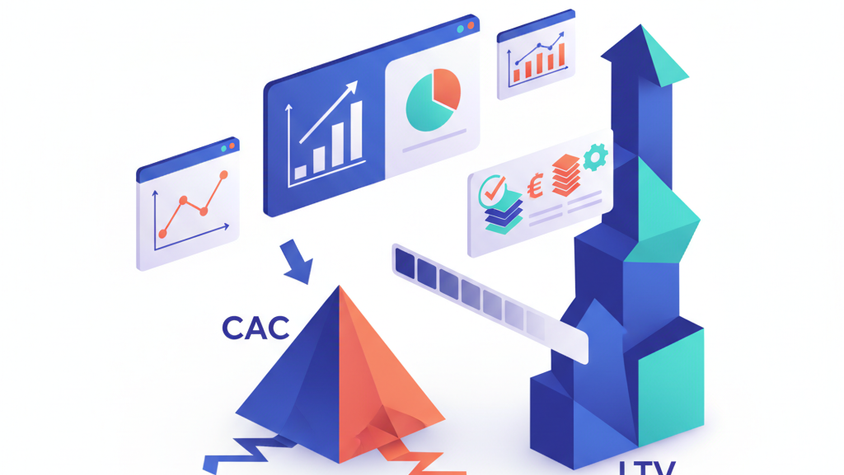
Bringing it together, Flowtly gives a full-context view of each customer: what it cost to acquire them, how much they’ve spent with you so far, how much support or service they’ve needed, and whether their activity is trending up or down. As one analyst succinctly said, “until you know exactly how much net value each customer brings, growth decisions are guesswork.” Flowtly removes the guesswork by backing LTV with hard data.
Example: SaaSCo uses Flowtly to track both finances and projects for their software product. Through Flowtly, they notice that customers coming from their Channel Partner program have a different usage pattern than those from direct online signups. A Channel Partner client usually has a dedicated account manager (additional cost) and logs many more support hours in the first month (onboarding cost). However, they also tend to stick around for 3+ years on a high-tier plan. In contrast, self-serve clients have almost no service costs but about 30% of them churn after 6 months. By looking at cohorts in Flowtly, SaaSCo calculates: Channel clients’ average LTV is $50k revenue over 3 years with $10k support cost = $40k net LTV. Self-serve clients’ average LTV is $5k revenue over 1 year with negligible support cost = ~$5k net LTV. The insight? Even though the Channel clients required more upfront cost and effort, their net lifetime value is eight times higher than the self-serve ones. Flowtly’s real-data tracking allowed SaaSCo to see this clearly. Armed with this, SaaSCo decides to invest more in the Channel Partner program (despite its higher CAC) because the payback is superior. They also put effort into improving onboarding for self-serve customers to try to boost that cohort’s retention (and LTV).
Turning Data into Decisions: Clear Insights, Not Vanity Metrics
Having all this data is powerful, but the end goal is action. Flowtly is built to not just collect numbers, but to highlight what they mean for your business strategy. The platform delivers insights that help you decide where to focus and what to cut, saving you from getting lost in endless dashboards or chasing feel-good vanity metrics.
What do we mean by vanity metrics? These are numbers that look impressive but don’t necessarily correlate with business health or guide decision-making. For example, “website visitors” or “total signups” might go up, but if CAC is too high or those signups don’t stick around (low LTV), the vanity growth is meaningless. Flowtly steers you toward metrics that matter: customer acquisition cost, customer lifetime value, and ultimately customer profitability – all in context of budgets and real costs.
Here are a few clear insights Flowtly helps you discover:
- Which clients are worth investing more in (and which aren't): By ranking customers by profitability and LTV, you can quickly identify your best customers—those who generate healthy profit with minimal headache. Flowtly’s data might show, for instance, that Clients in the Tech industry have 30% higher LTV and require 20% less support time than those in Retail. That’s a clear signal to prioritize Tech industry clients in your marketing and account management. Conversely, if a few clients are actually unprofitable (their costs exceed their revenue), Flowtly makes them visible so you can address the situation. This could mean renegotiating contracts, upselling, or in some cases, firing the customer. As harsh as that sounds, freeing resources from unprofitable clients can be the smartest move – and it’s better to base it on data than gut feel. Remember, “customer profitability analysis helps uncover which customers or segments are most (and least) profitable, and where to prioritize resources.” Flowtly provides the analysis; you execute on it.
- Which channels or campaigns deserve more budget: Instead of blindly increasing the marketing budget by X% each quarter, Flowtly’s channel-level CAC and ROI tracking lets you invest with confidence. If one channel consistently brings in high-LTV customers at a reasonable CAC, you know that’s where your next dollar should go. On the flip side, if a campaign is spending thousands with nothing to show for it, you’ll see the red ink and can shut it down. As highlighted earlier, when you accurately track CAC and LTV, “you know exactly which channels generate profitable customers, when to scale spending, and where to cut budget without sacrificing pipeline quality.” This means you can grow faster by investing more in the effective channels and stop wasting money on efforts that don’t deliver real value. Flowtly’s real-time budget alerts and reports ensure you catch these insights quickly – no more waiting for end-of-quarter surprises.
- Where your budget is leaking: Flowtly can reveal inefficiencies that aren’t obvious from high-level metrics. For example, maybe your overall CAC is on target, but Flowtly shows a particular campaign had an unusually high cost per acquisition – upon investigation, you find an unchecked software subscription or an over-budget freelance contract was the culprit. Or perhaps one customer segment has a sneaky high churn rate, meaning you’re losing LTV on those customers – Flowtly’s client lifetime tracking flags that pattern so you can respond (either improve retention or stop targeting that segment). In short, Flowtly acts like a financial watchdog, monitoring budgets, detecting anomalies, and suggesting changes in staffing or costs. It’s like having an analyst on duty 24/7, pointing out “Hey, this client took double the hours this month” or “Our spend on Channel X went up but revenue didn’t – investigate.”
- Validated decision-making (no more guesses): Perhaps the most important outcome is confidence. As a business owner, you always have to make calls – which market to go after, how much to spend on marketing, which clients to focus on, etc. Those decisions are much easier when backed by concrete data. Flowtly gives you a Single Source of Truth for finance and operations, so your team isn’t arguing over whose spreadsheet is right. You see the same truth and can move fast. The system “unites HR, finance and operations into a single coherent system... replacing scattered tools and manual reporting.” By operating from one set of numbers that you trust, you can be direct and decisive. Instead of meeting about why numbers don’t match, you’ll meet about how to respond to what the clear numbers are telling you.
Ultimately, Flowtly’s focus on budgets, CAC, LTV, and profitability shifts your mindset from vanity to value. It’s not about patting yourself on the back for adding 1,000 users who never convert – it’s about zeroing in on net growth. When an insight emerges (say, a channel with poor payback or a client with stellar margin), Flowtly helps you act immediately: reallocate funds, adjust strategy, or even automate a response. The platform’s aim is to ensure “every process translates into measurable business outcomes.” That’s the kind of clarity ambitious owners need.
Conclusion: Clarity You Can Act On
For too long, small and mid-sized companies have struggled to get a clear view of CAC and LTV. It was either do heavy spreadsheet lifting or fly blind on averages. Flowtly changes that. By using real budget data – every cost and every revenue – Flowtly provides an honest, up-to-date picture of what it truly costs to acquire customers and what those customers are actually worth over time.
This clarity isn’t just academic. It helps you make better decisions, faster. You’ll know which marketing dollars are working and which aren’t. You’ll see which clients make you money and which quietly drain your resources. You’ll have the facts to scale up what works, cut what doesn’t, and thereby improve your CAC:LTV Ratio (a key indicator of sustainable growth). In short, you’ll run your business with the kind of financial sharpness usually found in big enterprises – except you’ll do it with an intuitive tool that doesn’t require a finance degree to interpret.
Ambitious company owners have a lot on their plate, but with Flowtly managing the financial details and analytics, you get the strategic insight you'd expect from a dedicated finance and operations leader. No more vanity metrics. No more comforting yourself with “we got 1000 likes on the campaign” while the bank account tells another story. Flowtly will show you the story the numbers are telling, plainly and confidently.
In an environment where every dollar counts, having this level of insight can be the difference between scaling smart and stumbling. Flowtly’s sharp, straightforward data keeps you honest and focused on profitability. So, if you’re ready to turn your budget from a black box into a clear guide for decisions, Flowtly might just be the tool that gives you the clarity – and the advantage – you’ve been looking for.
Remember: what gets measured gets managed. With Flowtly measuring the right things (CAC, LTV, and all the factors driving them), you’re equipped to manage and grow your business with your eyes wide open. That’s real power for a company on the rise.
Key takeaways
- Flowtly tracks all acquisition costs (including hidden ones) for an accurate CAC.
- It attributes costs and revenue to specific channels, campaigns, and clients.
- This reveals true profitability per customer, moving beyond aggregate views.
- LTV is calculated using actual revenue, costs, and engagement data, not estimates.
- Data-driven insights empower confident decisions about where to invest and cut.
- Flowtly creates a single source of truth for financial and operational performance, boosting strategic clarity.
